What causes nasal pinching after rhinoplasty?
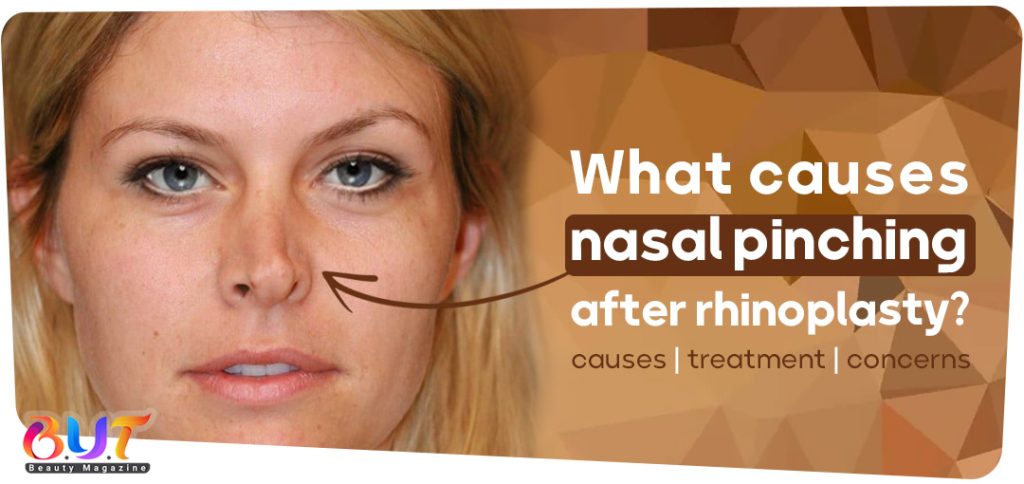
A pinched nasal tip occurs due to weakening of the nasal wing (ala of nose – ala nasi), which narrows the airway in the nose and causes problems such as difficulty breathing. The wings are the narrowest path in the nose for airflow and are located in the middle to the bottom of the nose.
The main function of this part of the nose is to control the amount of air flow. Because the structure of wing is narrow, if another factor, such as rhinoplasty, makes the nostrils narrower, the amount of air flow through the nose will be reduced and in more severe cases it might be completely cut off. In this article, we will discuss the cause of nasal pinching and offer solutions for treating it after surgery.
What is the structure of ala nasi?
The alae nasi are made up of two parts; External and internal
• The inner part of the alae nasi
Most people only know the inner part of the nostrils. The consistency of the nose is due to this part and it is located between the skin and the respiratory tissue of the nose.
• The outer part of the alae nasi
The outer part of alae nasi consists of three parts; The bone between your nostrils, the bottom of your nose, and the walls of your nose.

When does the outer part of the ala nasi cause the nose to pinch inward?
It should be noted that weakness or upward form of the nasal tip bone can cause the outer part of the nose pinch inward. During rhinoplasty, the lower part of your nasal walls may be removed, which weakens the outer part of alae nasi and causes them to pinch inward.
When does the inner part of the ala nasi cause the nose to pinch inward?
If the upper part of your nasal walls is weak or too narrow, the inner part of alae of your nose may become pinched when you breathe. If a part of the inside of the nose is removed during rhinoplasty, it is possible that the walls of the nose at the top of it will come close to each other, and thus, the nasal pinching will occur in the inner part of the alae.
Symptoms of having pinched nasal tip

- Difficulty breathing
- Nasal congestion
- Blockage of the nasal passage
- Nose bleeding
- Scaling around the nostrils
- Snoring
Steps to diagnose pinched nasal tip
To correctly diagnose nasal pinching until we reach the next steps, which is the treatment of postoperative nasal pinching, the following actions should be taken:
The patient’s medical history and signs of nasal congestion should be carefully examined first. The patient should then be examined for other problems associated with nasal pinching using endoscopy. Finally, to determine the cause of the nasal pinching, the cattell’s maneuver must be performed to determine whether the nasal pinching is more in the outer part of the alae or in the inner part of them.
Treatment of pinched nasal tip which happens after rhinoplasty
To treat a pinched nasal tip after surgery, you need to see which parts of your nasal wings have become narrower. Nasal pinching may have occurred in both inner and outer parts of nasal wings. If both the inside and outside of your nasal passages have been pinched inward, it is probable that your nasal airway would be completely blocked; But if only a part of it is abnormal, nasal breathing would be possible.
Use of medicines or some tools to treat pinched nasal tip

In the treatment of nasal pinching after surgery, using medications can be somewhat effective, and we will discuss some of them in the following.
Steroids such as Fluticasone can open the nasal airway a little, and this much opening is also helpful for patients with severe pinched nasal tip.
Gargling in the nose is also a common and safe solution that can rinse your nose and open your airways. It can make you feel better.
If you have allergies, you can use medications such as Loratadine and Cetirizine, which are anti-allergic and relieve nasal congestion to some extent.
In addition to the medications we mentioned, there are some tools, and if people do not want perform surgery, they might be able to solve some of their problems by using a nasal dilator. Some of these nasal dilators are placed outside the nose and open the nasal fins slightly; Others, made of silicone, are placed inside the nose. Both categories are commonly used at night and at bedtime. Of course, not enough studies have been done on the effectiveness of these tools.
If the use of such drugs and tools to treat pinched nasal tip after rhinoplasty does not work, you will probably need to do a revision operation.


No comments:
Post a Comment